
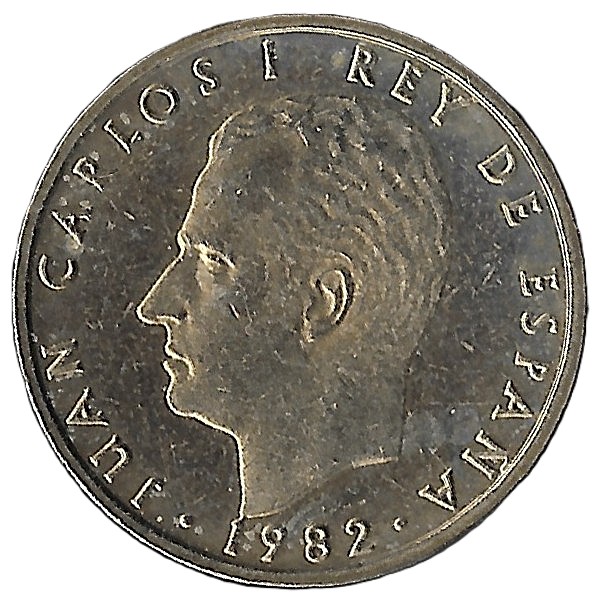
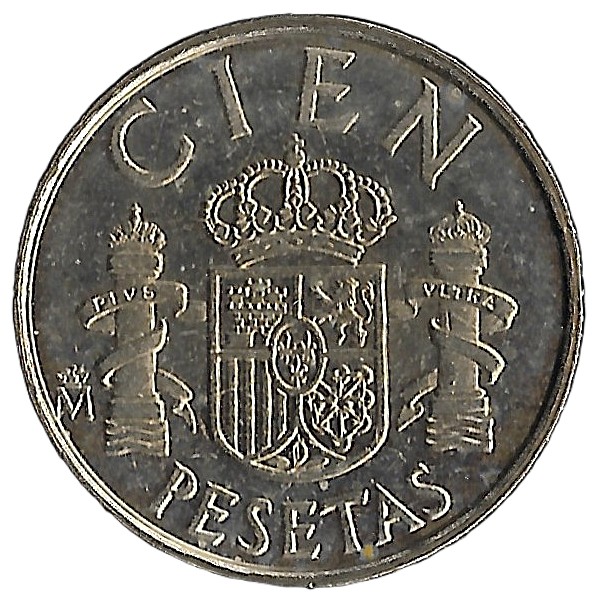
Spain. 1982. 100 Pesetas – Juan Carlos I. 9.25g. Aluminium-Bronze. Au. C616. RI.3
Design
Obverse:
Portrait of King Juan Carlos I, legend JUAN CARLOS I REY DE ESPAÑA 1982.
The portrait by engraver Luis J. Sánchez Toda shows a calm, modern monarch — a strong visual break from Franco-era austerity.
Reverse:
Large numeric 100 PTAS in center, crowned coat of arms of Spain above, with mint mark (M crowned) at right.
Simple, clear, and distinctly modern — designed for daily use rather than commemoration.
🏛️ Historical setting
-
From silver-tone to golden tone.
Spain shifted from heavy copper-nickel coins (17 g) to a much lighter aluminium-bronze alloy — a practical move as metal prices and production costs rose. -
The first “golden” 100 Pesetas.
It introduced the warm yellow color later used for all high-value coins through the 1990s, influencing the color palette of Spain’s later euro coinage. -
Economic modernization.
1982 was a key year: Spain prepared to join the EEC (European Union) and NATO, with an economy moving toward European standards. The new coinage symbolized efficiency and renewal. -
Everyday royal portrait.
Unlike commemoratives, this was a workhorse coin that circulated widely — it helped normalize the image of the constitutional monarchy among ordinary Spaniards.
💡 Interesting facts
-
Edge legend innovation.
Spain had rarely used full textual edge inscriptions on mid-denomination coins; this one added anti-counterfeiting flair and royal branding in one stroke. -
Practical design.
Reduced weight (almost half of the 1980 type) and smaller size made it pocket-friendly; vending machines and ticket machines were recalibrated for it. -
Transitional piece.
It bridged the large 1980 copper-nickel “España ’82” series and the smaller 1983–1989 coins. Think of it as the prototype for modern Spanish coin design. -
Golden glow without gold.
The aluminium-bronze alloy gave a rich golden tone that symbolized prosperity — nicknamed “la dorada de las cien pesetas.” -
Long life in circulation.
Despite debuting in 1982, these coins stayed common until the euro arrived in 2002 — two full decades of daily use. -
High-quality strikes.
The Royal Mint’s modern presses produced clean, almost proof-like surfaces; early uncirculated examples often show mirror fields and sharp hair detail on the king’s portrait.
💰 Collector value (approx.)
| Grade | Value (€) | Notes |
|---|---|---|
| Circulated | 1 – 2 | Common but historic |
| XF / AU | 2 – 3 | Nice color, light wear |
| UNC / BU | 4 – 6 | Bright golden lustre |
| Proof (mint set) | 8 – 10 | Scarcer finish |
🏁 In summary
The 1982 Spain 100 Pesetas aluminium-bronze marks Spain’s step into a new economic era — lighter, modern, and golden in tone.
It’s a coin of confidence: King Juan Carlos I’s calm portrait on the face of a nation ready to join modern Europe.
Reviews
There are no reviews yet.