AllCollect Discover · Coins & History
The Rupee That
Outlived an Empire
Three coins from my collection tell the story of British India, its final years, and the curious survival of a king’s portrait after independence.
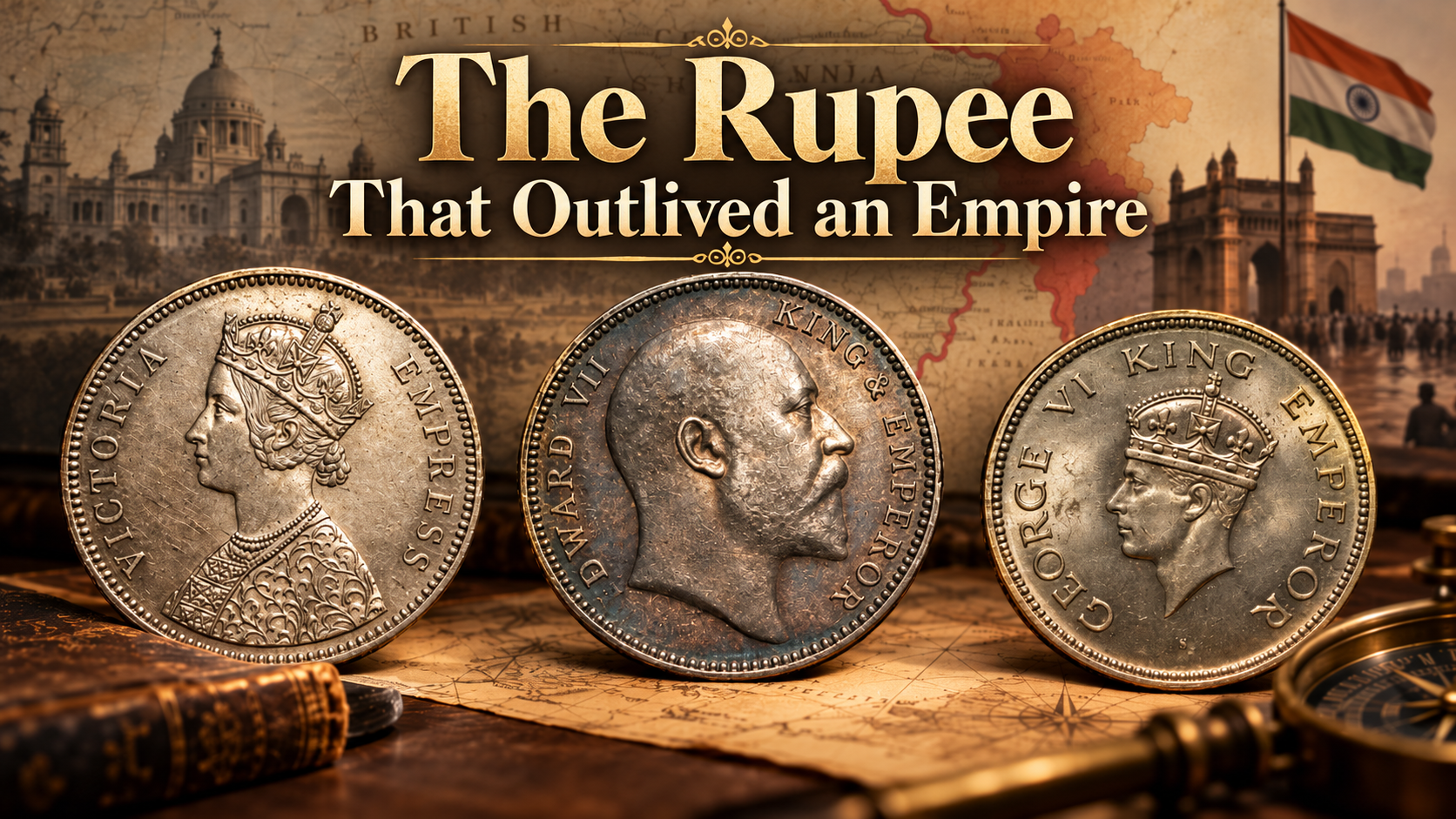
There is a particular pleasure in collecting old coins that has little to do with their rarity or market value. Sometimes a modest coin raises a question that leads you into a much larger story. You begin by examining a date or an unfamiliar mintmark, and before long you find yourself reading about wars, empires, political decisions and people whose lives were changed by events far beyond their control.
This happened to me recently while examining a 1947 Indian rupee that I had acquired for my collection.
The coin is made of nickel, weighs 11.8 grams and carries the portrait of George VI, King and Emperor. It has been graded MS 62 by NGC. A respectable example, certainly, but hardly a great numismatic rarity. More than 118 million rupees of this Bombay issue were struck.
What interested me was not the grade or the mintage. It was the date.
In 1947, British rule in India came to an end. Yet here was a coin bearing the portrait of the British king, with the words KING EMPEROR clearly visible.
It seemed a reasonable question to ask: what happened to these coins when the empire disappeared?
The answer turned out to be rather more interesting than I expected.
What happened to these coins when the empire disappeared?
A Short History of an Empire in Three Coins
To understand the 1947 rupee, I went back to two earlier Indian coins in my collection.
The first is a silver rupee dated 1885, issued under Queen Victoria. The second is another silver rupee, dated 1907, bearing the portrait of her son, Edward VII.
Together with the 1947 George VI rupee, they cover a period of sixty-two years, during which the British Empire reached the height of its power and then lost its most important colonial possession.
Looking at the three coins side by side, I was struck by how much they reveal about the changing relationship between Britain and India.
Victoria: An Empress on a Silver Rupee
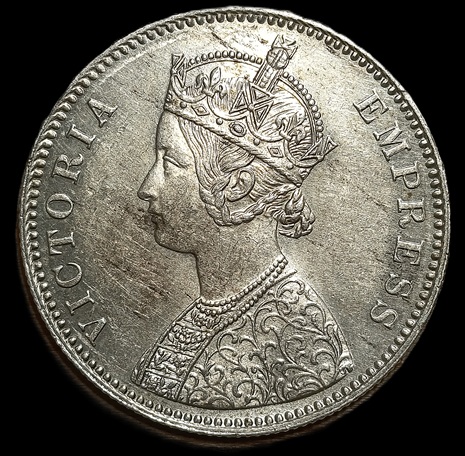
My 1885 rupee shows Victoria wearing an elaborate crown and richly decorated dress. Around her portrait appear two words: VICTORIA EMPRESS.
The inscription is significant.
Until 1858, much of British India had been governed by the East India Company. Following the Indian Rebellion of 1857, control passed directly to the British Crown.
Victoria received the title Empress of India in 1876, and the new imperial title appeared on Indian coinage from 1877.
The 1885 rupee therefore represents more than the reign of a monarch. It belongs to the period when the British government was deliberately presenting India as part of an imperial political order.
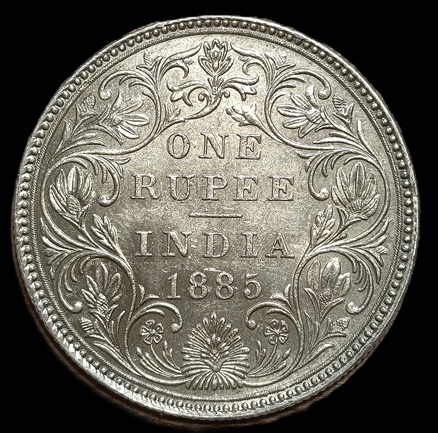
The reverse is quite different in character. Surrounded by an elaborate floral design are the words ONE RUPEE INDIA and the date.
I find the contrast interesting. One side proclaims imperial authority; the other is concerned with the practical business of identifying the currency.
My coin was struck at Bombay, or Mumbai as the city is known today. It is attributed to the raised-B mintmark variety, and I have provisionally identified the portrait as Bust Type A and the reverse as Type II.
For collectors of Victorian Indian rupees, these details matter. Different busts, reverse dies and mintmarks can distinguish one variety from another, even when the coins initially appear identical.
It is a useful reminder that historical interest and numismatic study are not separate activities. The history explains why a coin exists; the die details tell us exactly which coin we are holding.
Edward VII: A Different King, the Same Silver Standard
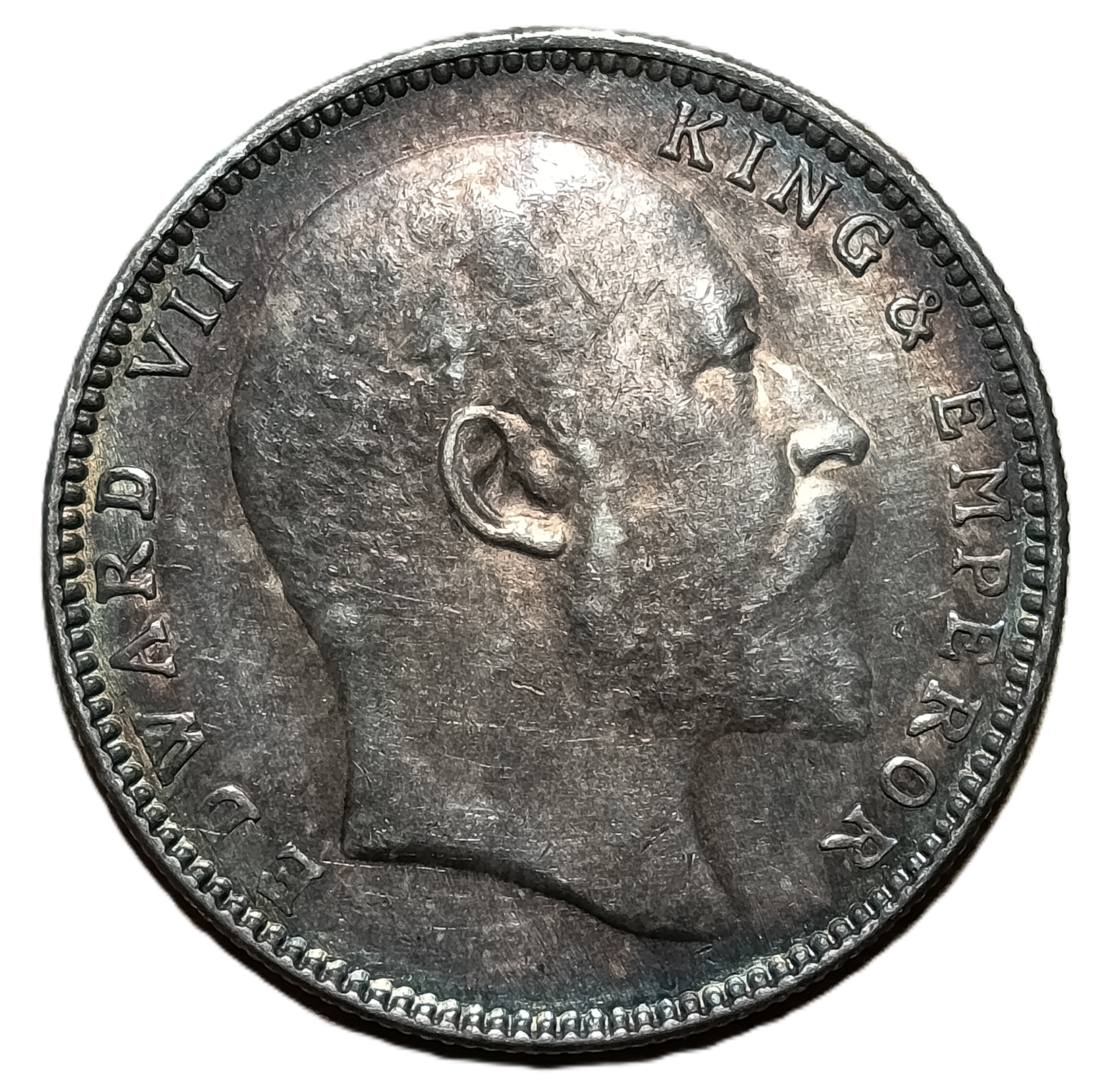
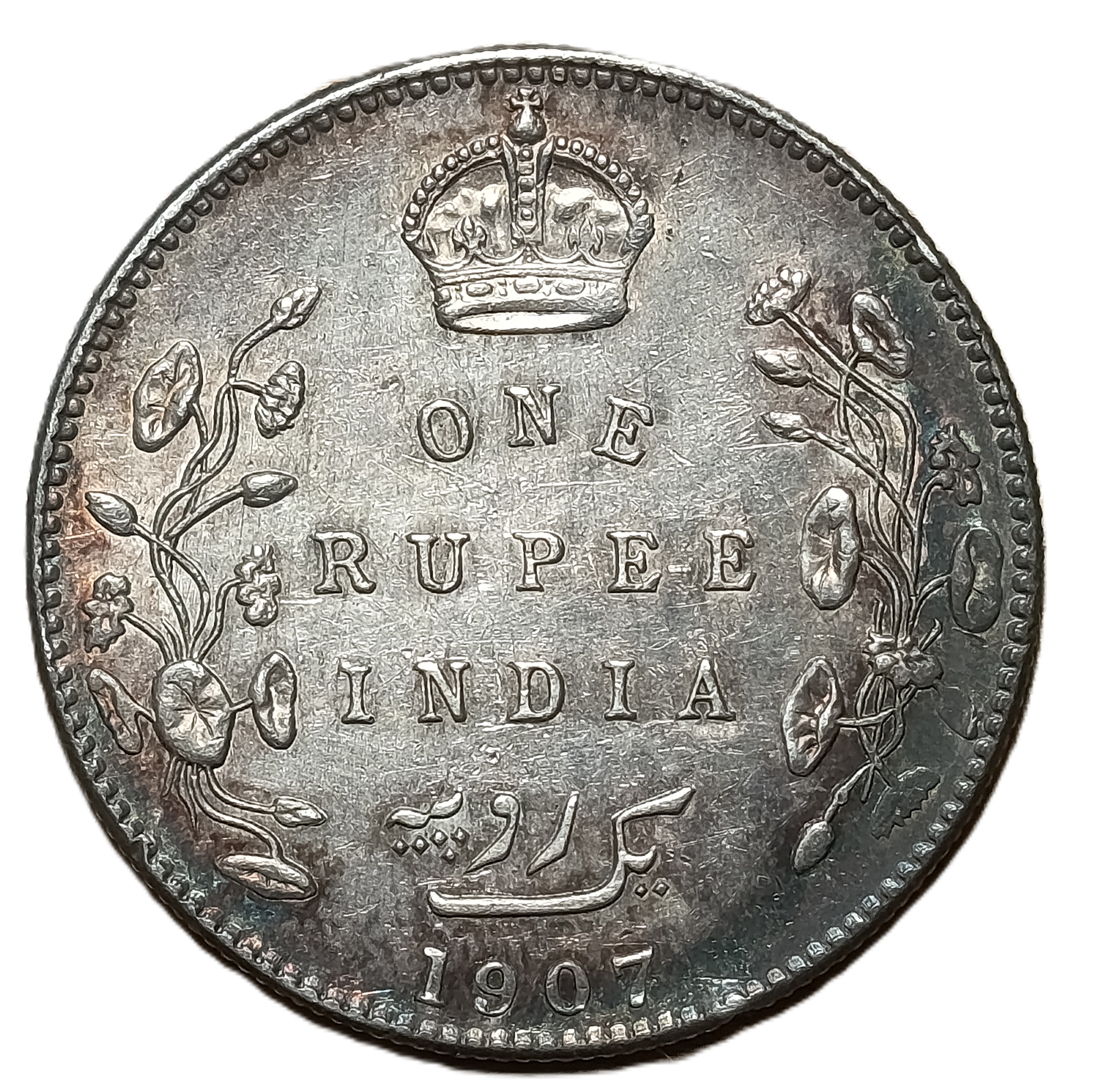
My second rupee, dated 1907, depicts Edward VII.
His portrait is less elaborate than Victoria's. There is no ceremonial dress, and the inscription reads EDWARD VII KING & EMPEROR.
The coin belongs to a different generation, but the familiar silver rupee remained an important part of India's monetary system.
Under the Indian Coinage Act of 1906, the rupee retained its established silver standard of approximately 91.7 per cent purity.
The 1907 coin in my collection shows considerable evidence of use. Its portrait has visible friction, the surfaces carry numerous fine marks, and the reverse has developed an uneven grey patina.
These characteristics are worth examining carefully. A coin that has circulated for many years may have perfectly legitimate wear, while cleaning can produce marks that tell a different story. Photographs alone do not always provide a satisfactory answer.
I have not yet conclusively established whether my specimen came from Bombay or Calcutta.
That uncertainty does not diminish my interest in it. On the contrary, it gives me another small numismatic question to investigate.
Looking at the 1885 and 1907 rupees together, one sees considerable continuity. The monarch changed, the portraits changed, but the general monetary system remained recognisable.
The great transformation was still to come.
Why Did the Silver Rupee Disappear?
One of the more surprising things I discovered while researching the 1947 coin is that its nickel composition was not primarily a consequence of Indian independence.
The change began under British rule.
For much of the nineteenth century, the rupee was closely associated with silver. Its weight and silver content were fundamental to the monetary system.
But by the twentieth century, precious-metal coinage was becoming increasingly difficult to maintain.
The First World War created serious pressures on silver supplies. During the Second World War, these problems became even more acute.
The British Indian authorities progressively reduced the silver content of the rupee. The last George VI rupees of the traditional .917 silver standard were dated 1939, followed by coins containing 50 per cent silver.
Eventually even this reduced silver content proved impractical.
In 1947, the silver rupee gave way to a nickel coin.
The new rupee weighed 11.8 grams, slightly more than its silver predecessors, but its value no longer depended on its silver content.
This change was part of the wider movement away from precious-metal currency towards modern token coinage.
What particularly interested me was the timing.
The decision to issue the nickel rupee was taken before Britain formally relinquished power in August 1947.[1]
In other words, the coin that we now associate with the end of British India was actually conceived as part of the late colonial administration's monetary reforms.
This is a detail that changes the way I look at the coin.
Its metal tells us about wartime economics. Its portrait tells us about imperial authority. Its date places both developments at a moment of extraordinary political change.
August 1947: The Empire Ends
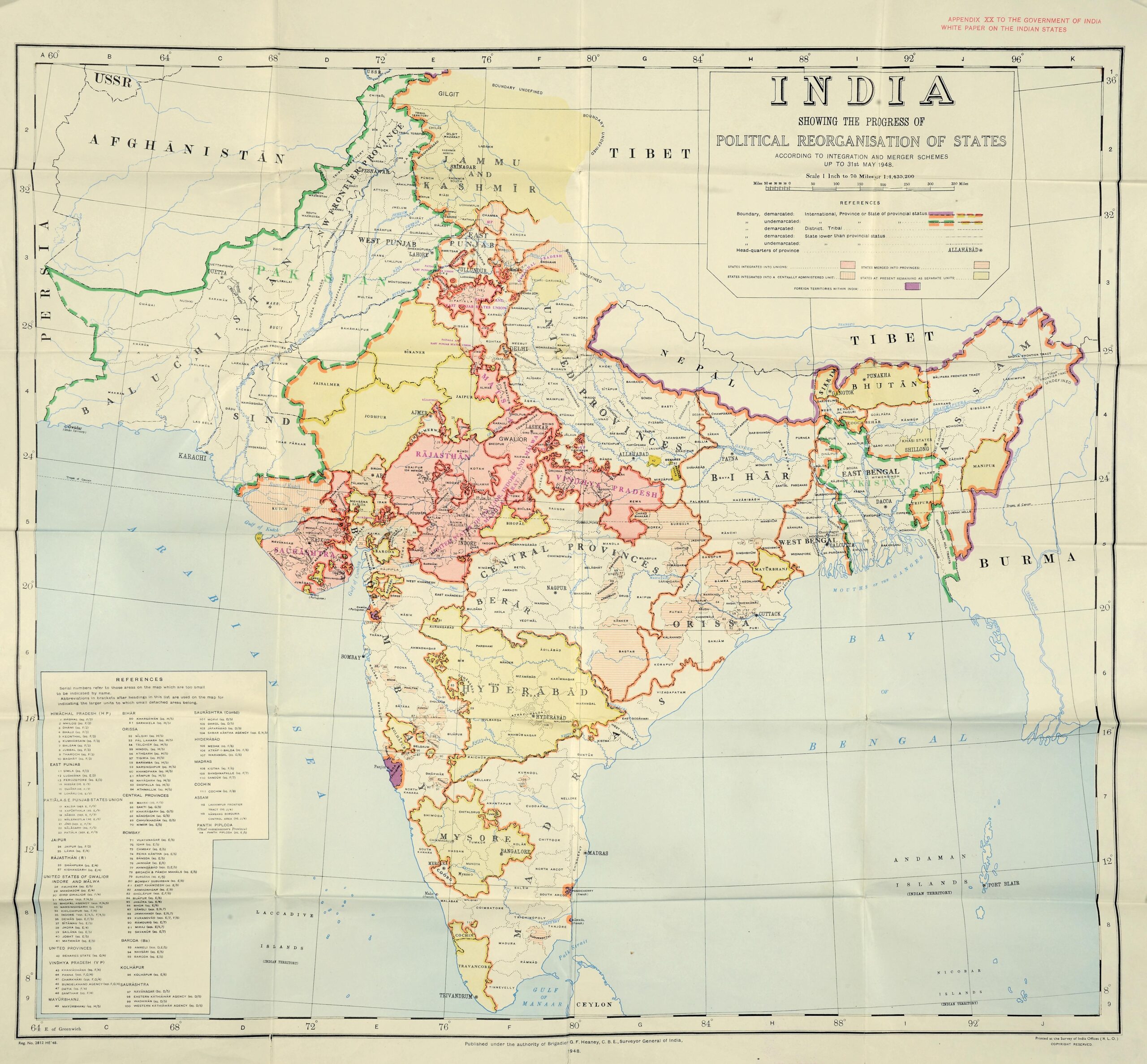
In August 1947, British rule ended and two independent dominions emerged: Pakistan, which celebrates independence on 14 August, and India, on 15 August.
For Britain, this was the end of nearly two centuries of expanding political and economic involvement on the subcontinent.
For the people of India and Pakistan, independence was accompanied by a much more complicated reality.
The partition divided provinces, communities, transport networks, administrative institutions and families.
Punjab and Bengal were partitioned. Millions of people moved across the new borders, often under terrifying circumstances.[3]
Hindus and Sikhs travelled towards India, while many Muslims moved towards Pakistan. The migrations were accompanied by extensive communal violence, the destruction of homes and a tremendous loss of life.
The photographs from that period are difficult to look at.
Crowded refugee trains, columns of displaced families and the aftermath of communal disturbances remind us that political independence, however long awaited, came at an immense human cost.
As a collector, I think it is important to remember this broader context. A coin is a small object, but the year stamped on it may represent very different things to different people.
For some, 1947 meant liberation and the beginning of a new national life. For others, it also meant the loss of their homes, relatives and familiar surroundings.
A rupee dated 1947 cannot tell us which of these experiences belonged to the people who handled it. But it can encourage us to learn about them.
The King Remained on the Coin
Now we return to my original question.
What happened to the rupees bearing the portrait of George VI after independence?
The simple answer is that they continued to be used.
Governments can change relatively quickly. Monetary systems are much more difficult to replace.
Coins must be designed, dies prepared, metals obtained, production arranged and enormous quantities distributed throughout a country.
Existing currency also has to remain usable while the replacement system is being introduced.
India faced these practical problems at precisely the moment when its new government was dealing with partition, refugee movements, administrative reorganisation and economic uncertainty.
Unsurprisingly, the new authorities did not immediately withdraw all the coins bearing British royal portraits.[2]
Instead, the existing currency system continued during a transitional period from 1947 to 1950, sometimes referred to in Indian numismatic literature as the Frozen Series.
This meant that coins carrying the words KING EMPEROR remained part of the currency arrangements of independent India.
There is a curious historical irony here.
British colonial rule had ended, yet the coin itself remained perfectly useful. George VI remained King of independent India until it became a republic in 1950; the imperial title was formally removed from his royal style in 1948.
Its purchasing power did not disappear simply because the constitutional position of the monarch had changed.
I find this one of the most interesting aspects of the 1947 rupee. It reminds us that history rarely divides itself into neat chapters, even when our history books assign precise dates to major events.
A Tiger on the Reverse
The reverse of the 1947 rupee is, in my opinion, much more appealing than the obverse.
A tiger walks across the centre of the coin. Above it appears ONE RUPEE, while the denomination is also given in Devanagari and Urdu. Below the animal are the word INDIA and the date 1947.
The design was created by Patrick Brindley, while the portrait of George VI was the work of Percy Metcalfe.[4]
It is an attractive composition. The tiger occupies the centre without making the inscriptions difficult to read, and the use of three scripts gives the coin a distinctly Indian character.
But we should be careful about interpreting its symbolism.
It would be tempting to describe the tiger as a proud symbol of the newly independent country.
The difficulty is that the design originated under the colonial administration.
The tiger was not introduced to celebrate independence. It was already part of the planned nickel rupee issue before August 1947.
For me, this makes the coin more interesting rather than less.
On one side is the British king. On the other is an animal strongly associated with India, accompanied by inscriptions intended for a multilingual population.
The design reflects the complexities of late colonial India rather than a single, simple political message.
Bombay, Lahore and a Tiny Mintmark
There is one more detail on the reverse that collectors should examine.
Below the date, some 1947 rupees carry a small diamond-shaped mintmark.
This identifies the Bombay issue.
Coins struck at Lahore generally have no mintmark in that position.
Before partition, Bombay and Lahore were both important cities within British India. After partition, Bombay remained in India, while Lahore became part of Pakistan.
The distinction gives us an interesting connection between numismatics and political geography.
According to the Numista catalogue, approximately 118 million diamond-marked Bombay rupees were struck, compared with about 42 million unmarked Lahore examples.
These figures immediately tell us something important: the ordinary 1947 rupee is not rare.
Collectors should not confuse an attractive historical story with numismatic scarcity.
It is also worth distinguishing the normal Bombay circulation issue from the separately catalogued proof variety bearing a B designation.
My certified coin carries the NGC attribution 1947(B) INDIA RUPEE. When classifying it in my collection, I retain the exact wording of the certification label and distinguish it from the separate proof listing.
Small differences of this kind may appear unimportant to someone outside the hobby, but they are precisely the details that make coin collecting such an absorbing pursuit.
Independence Finally Appears on the Coins
India became a republic on 26 January 1950.
The new political status required a new visual language for its currency.
On 15 August 1950, the first distinctive coinage of the Republic of India was introduced.[2]
The portrait of George VI disappeared. In its place came the Lion Capital of Ashoka, derived from the ancient pillar at Sarnath.
On the rupee, the tiger was replaced by a design featuring ears of grain.
The contrast is striking.
The royal portrait had represented dynastic authority. The new national emblem referred instead to India's own historical and cultural traditions.
The replacement of the tiger by agricultural imagery was also associated with ideas of prosperity and progress.
The denomination remained the rupee, however, and the monetary system was still based on sixteen annas to the rupee.
Only in 1957 did India introduce decimal coinage, dividing the rupee into one hundred naye paise.[5]
Thus even after the British monarchy disappeared from Indian coins, other aspects of the older monetary system survived for several more years.
Political independence, a new national coinage and monetary reform were three distinct stages, not a single event.
My 1947 Rupee: NGC MS 62
The particular coin that prompted this research is catalogued in my collection as C833.
It was struck at Bombay in 1947 and is encapsulated by the Numismatic Guaranty Company, with a grade of MS 62.
The certification number is 8189745-052.
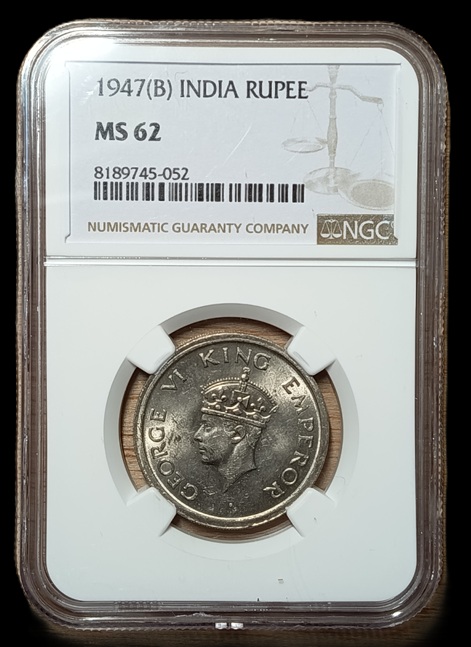
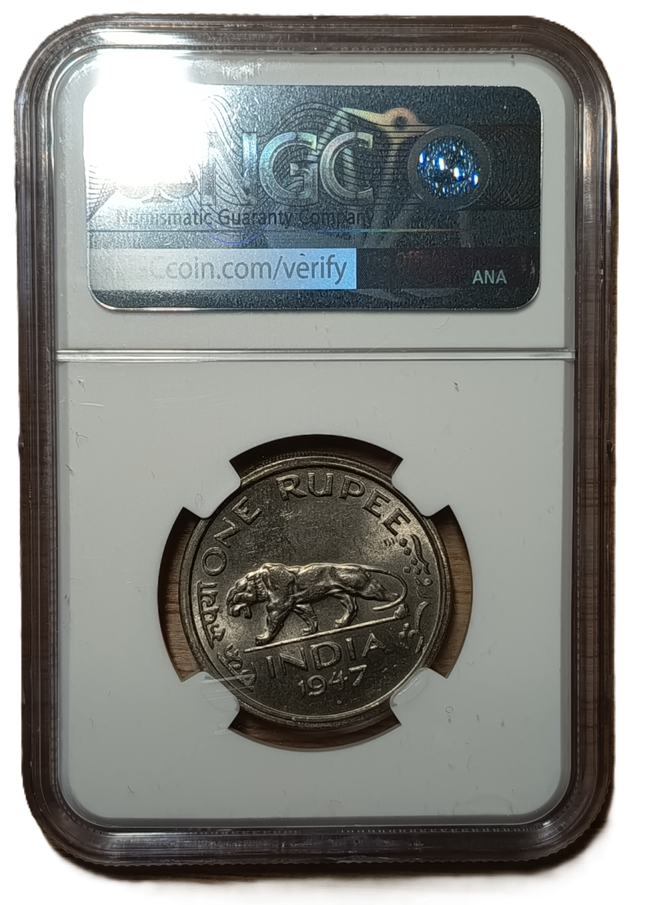
MS stands for Mint State, meaning that the grading service considers the coin to show no wear from circulation. The numerical grade of 62 indicates that it is an uncirculated specimen, although contact marks, surface quality and overall appearance prevent it from receiving a higher grade.
I bought the coin at a CoinsNB auction for €30, or €35.40 including the buyer's premium.
This is not a particularly expensive coin, and I do not regard it as an exceptional investment.
Its original mintage was enormous. Even in certified condition, a specimen graded MS 62 is not automatically scarce.
Nevertheless, it has several qualities that make it worth keeping.
It is a tangible example of the transition from silver to nickel coinage. It was struck in the year of Indian independence. It carries both British imperial and Indian visual elements. And its certification provides an independent assessment of condition, something that can be useful when comparing examples or considering eventual resale.
Above all, it has given me a reason to study a period of history that extends far beyond numismatics.
That, for me, is one of the strongest arguments for building a collection rather than simply accumulating coins.
What the Three Rupees Tell Me
I began this investigation with three coins.
The 1885 Victoria rupee represents an empire that was confident enough to place its imperial title prominently on the currency of India.
The 1907 Edward VII rupee shows the continuity of the imperial monetary system, still based on silver and still carrying the portrait of a British monarch.
The 1947 George VI rupee belongs to a very different world. The silver has disappeared, political authority is about to change, and the same coin design will continue into the first years of independence.
Placed together, the three coins make a small historical sequence.
They do not explain every aspect of British rule in India, and they certainly cannot convey the full experience of the people who lived through it.
But they provide a way into the history.
An inscription leads to a constitutional change. A change in metal leads to wartime economic policy. A tiny mintmark leads to the geography of partition. A portrait leads to the question of how a newly independent country replaces the symbols of its former rulers.
The more closely I examine these coins, the more questions they seem to raise.
And that, I think, is what makes collecting so rewarding.
Sometimes the best coin in an album is not the rarest or the most valuable.
It is the one that persuades you to open a history book.
Coins from My Collection
C828 — British India, 1885, One Rupee, Victoria Empress Silver .917. Bombay Mint, raised-B variety. KM 492. Bust Type A; reverse subtype provisionally attributed as Type II.
C832 — British India, 1907, One Rupee, Edward VII Silver .917. KM 508. Mint attribution pending confirmation. Approximately XF to low AU based on photographs.
C833 — British India, 1947, One Rupee, George VI Nickel. Bombay Mint. KM 559. NGC MS 62, certification no. 8189745-052.
Notes & Sources
- The nickel reform. “Notes on Colonial Coins”, British Numismatic Journal 37 (1968), p. 171, records the 18 April 1947 amendment and 24 May notification authorising the nickel rupee. Read the research (PDF).
- Continuity and the Republic’s coinage. Reserve Bank of India, Republic India Coinage, sections “The Frozen Series 1947–1950” and “The Anna Series”. RBI Museum. See also the India Government Mint, Kolkata.
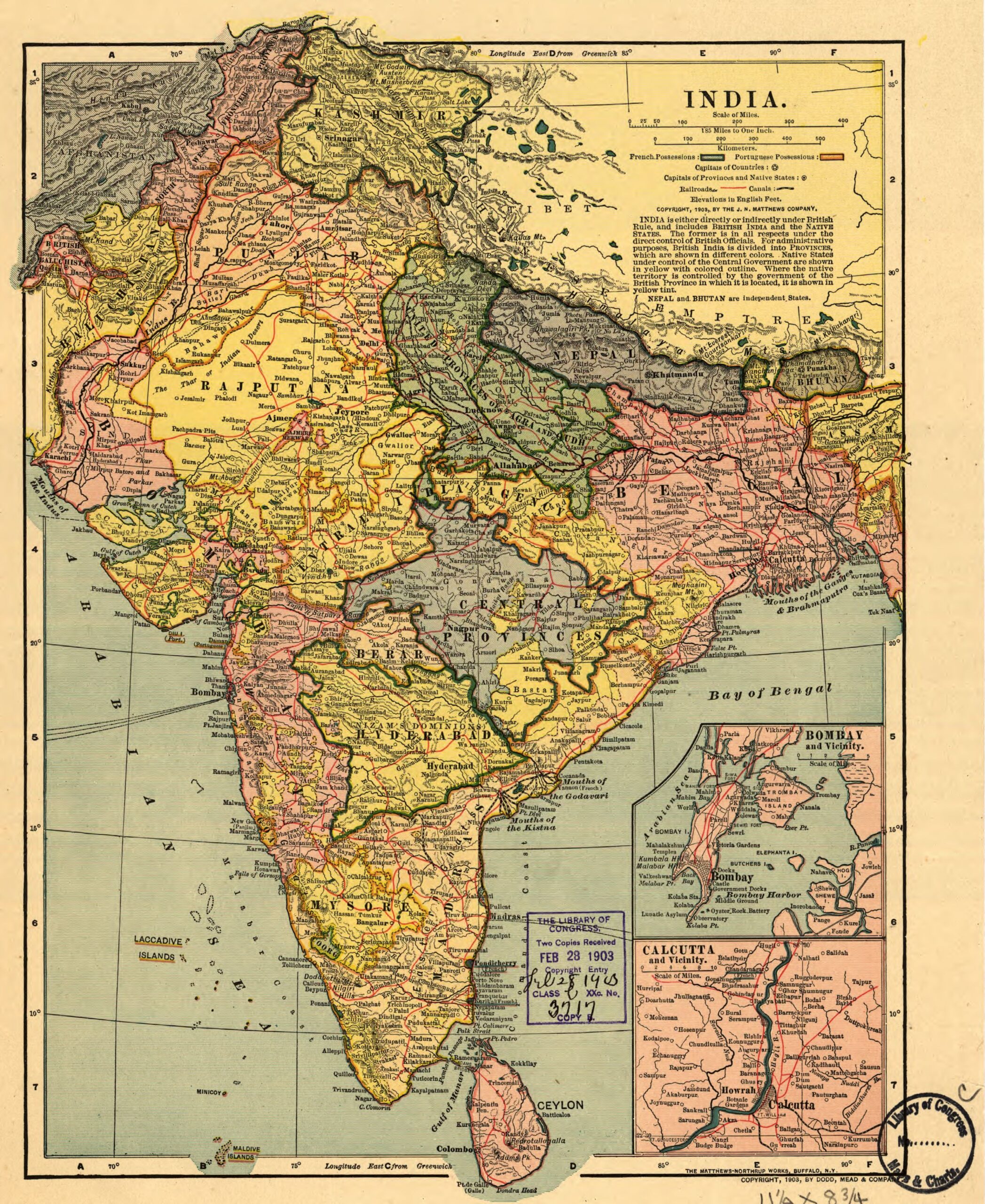
- Partition and its human consequences. The National Archives (UK), Partition of British India: contemporary documents and historical context. The maps reproduced here are historical documents; their boundaries and terminology should be read in their original context.
- Type references. Numista: Victoria, KM 492; Edward VII, KM 508; George VI, KM 559. We use catalogue data, not third-party coin photographs. Mintages are catalogue estimates and may differ between references.
- Decimalisation. Government of India, Press Information Bureau, Decimal Coinage — a Fascinating History: the reform took effect on 1 April 1957.
- Royal titles and the wider sequence. The Royal Mint, Empire to Independence: Six-Coin Rupee Set, including the removal of the imperial title on 22 June 1948.
Image credits. Coin photographs: the author’s collection, reproduced without AI enhancement. 1903 map: Dodd, Mead & Company / Library of Congress, public domain. 1948 map: The National Archives (UK), DO 142/484(1), released through Flickr Commons with no known copyright restrictions. Full image records are linked in the captions.