
When a Strange Stamp Edge Is Not a Fault
A practical note on perforation, roulette, and what stamp edges can tell us
The more stamps I examine, the more I realise how easy it is to look at perforation too superficially.
For a long time, I tended to reduce the whole subject to one question: What is the perforation gauge?
11? 12½? 14?
That is useful, of course. But it is only one part of the story.
A stamp edge can tell us much more.
Sometimes what first looks like poor perforation, damage, trimming or an odd production flaw is actually a normal feature of the issue. And sometimes the exact shape of the edge is one of the things that identifies the stamp correctly.
That was the point I took from studying the chapter on separation in Richard Cabeen’s Standard Handbook of Stamp Collecting.
“A strange edge is not automatically a defect. It may be a production feature, a recognised variety, or an important clue to identification.”
Four different things can be hidden in one stamp edge
When I now look at a perforated stamp, I try not to ask only for the gauge. I separate the question into four parts:
These are not the same thing.
A stamp can have the same gauge as another and still have visibly different holes. And two stamps can have edges that look similar at first glance while having been produced by completely different methods.
That distinction matters.
“Useful habit: do not record only “Perf 11½”. Record what the edge actually looks like when it matters.”
Perforation and roulette are not the same
The simplest way to remember the difference is this:
With normal perforation, small pieces of paper are punched out.
With roulette, the paper is slit, pierced or weakened so that the stamps can be torn apart.
After separation, both can produce a toothed-looking edge. That is exactly why they can be confused.
This becomes especially interesting with unusual forms.
“If paper has been physically punched out, think perforation. If the paper has only been cut or pierced, think roulette.”
Lozenge perforation
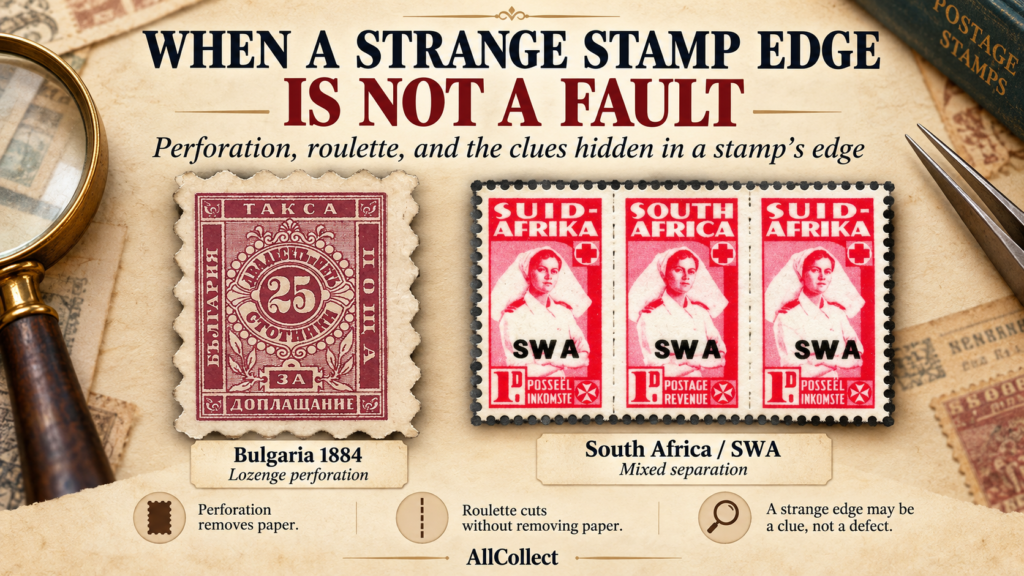
One example is lozenge perforation.
Instead of the usual round perforation holes, the openings are diamond-shaped.
An often-cited example is the Bulgarian postage due issue of 1884.
At first sight, the edge can look rather rough or strange. But the shape is intentional. It was produced by diamond-shaped pins, or square pins set diagonally.
The important point is that paper was actually removed.
So this is true perforation.
For me, this is a good reminder that an unusual edge should not immediately be treated as damage.
Specialist literature on the first Bulgarian postage due issue describes the characteristic diamond-shaped perforation holes, which create the serpentine-looking edge after separation.
That is a perfect example of why visual appearance alone can mislead: the edge looks unusual, but it belongs to the original production method.
Why this is easy to misread
The Bulgarian issue is especially instructive because catalogue and specialist terminology can vary. Some sources describe the early form as lozenge perforation, others emphasize the resulting serpentine or zig-zag appearance after separation. The underlying lesson is more important than the label: the form of the edge comes from how the paper was originally pierced or punched, not from later damage.
For a collector, this means the first question should be:
“Is this edge original to the issue?”
Not: Why is this stamp damaged?
Lozenge roulette
Now comes the confusing part.
There is also lozenge roulette.
Here the paper is pierced by pointed tools that spread the fibres into a diamond-like shape, but the paper itself is not punched out.
Visually, the result can resemble lozenge perforation.
Technically, however, the two are different.
That means the collector needs to look more closely at the physical structure of the edge rather than rely on the general appearance.
This is exactly the sort of small technical distinction that can separate a correct attribution from a wrong one.
“Lozenge perforation removes paper; lozenge roulette mainly displaces and cuts fibres.”
Mixed separation
The part I found most interesting was mixed separation.
This is when one stamp uses more than one system of separation.
For example: perforated at the top and bottom; rouletted at the sides.
At first glance, this can look as if one side has been damaged or badly cut.
But sometimes it is completely normal for the issue.
A good example is found in the small South African “Bantam” War Effort stamps of the 1940s. Some were produced with perforation on some sides and roulette on others.
That is a very useful lesson.
If a stamp edge looks inconsistent, I now ask: Was it made that way? — before asking: Was it damaged later?


Even where the exact mixed-separation pattern varies by value and format, these South African wartime issues are a good visual reminder that one stamp can legitimately show different edge treatments.
Why this matters in valuation
For a cheap common stamp, this may be little more than an interesting technical detail.
For a better stamp, it can affect catalogue identification, variety attribution, rarity, condition assessment, and market value.
And there is another danger.
A genuine production feature can be mistaken for damage.
But the reverse can also happen: later trimming, reperforation or manipulation can be mistaken for an unusual original form of separation.
So the collector needs both curiosity and restraint.
“Unusual separation can create value, but only if it is correctly identified as original and catalogue-relevant.”
My practical rule now
When I see an unusual edge, I no longer write “bad perforation” too quickly.
I check: Gauge → hole size → hole shape → separation method.
Only after that do I decide whether I am looking at normal production, a recognised variety, an error, damage, or possible later alteration.
That takes a little more time, but on interesting material it can be time very well spent.
A simple working sequence
Is it normal for the issue?
Large, small, round, elongated, diamond-shaped?
Was paper removed, or only cut/pierced?
Are they the same, or is this mixed separation?
Do not call something a defect before checking whether it is original.
One small change in the way I examine stamps
The most useful thing I took from this subject is probably not a new term.
It is a change in habit.
A strange edge is no longer an answer.
It is a question.
And that is usually where the more interesting part of philately begins.
A stamp edge can carry information about gauge, hole size, hole shape, production method, variety, authenticity, and condition.
“Before calling an edge damaged, first ask whether it was made that way.”
Richard Cabeen, Standard Handbook of Stamp Collecting, chapter on stamp separation.
South Africa 1942–44 Bantam War Effort issue — specialist reference.
Wikimedia Commons — original SWA stamps and image credit.
Technical note: The perforation/roulette comparison above is a schematic illustration, not a reproduced postage stamp. Historic examples should be checked against specialised philatelic references.
ALLCOLLECT.ONLINE · STAMPS TELL STORIES