
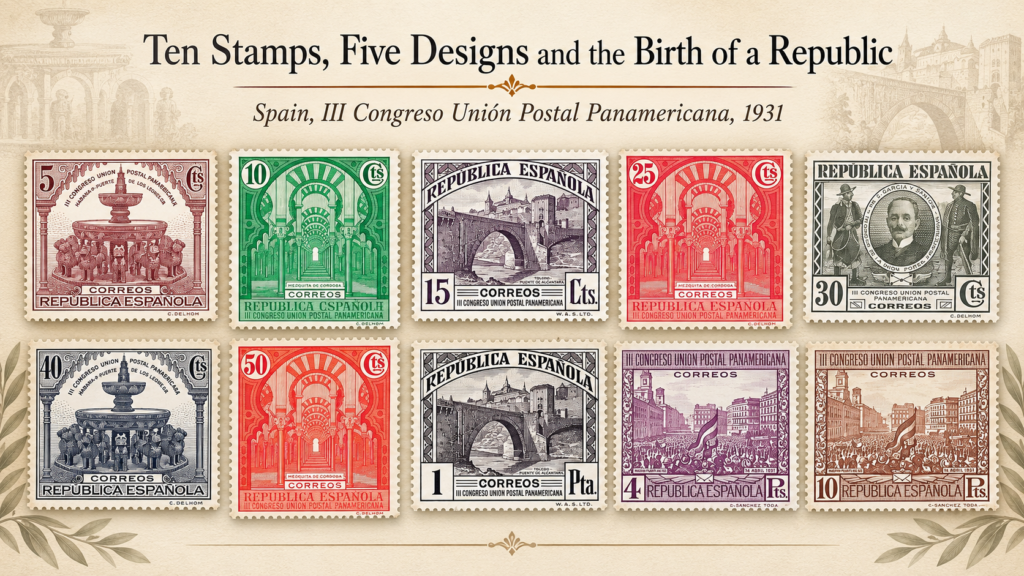
A collector’s guide to the Third Pan-American Postal Union Congress issue, Edifil 604–613.
In October 1931, Spain issued a remarkable series of ten stamps commemorating the Third Congress of the Pan-American Postal Union in Madrid. Beautifully engraved architectural scenes, an international postal pioneer and images of the newly proclaimed Spanish Republic came together in one historically revealing issue.
For collectors of early Republican Spain, this is more than an attractive commemorative set. It is a miniature record of a country redefining its identity.
Spain in 1931: A Republic Meets the Americas
On 14 April 1931, Spain’s Second Republic was proclaimed following the departure of King Alfonso XIII. Only six months later, Madrid hosted the Third Pan-American Postal Union Congress.
The congress was significant for international postal cooperation and for Spain’s relationship with the American republics. It also gave the new government an opportunity to present Spain’s history, cultural heritage and republican identity through postage stamps.
The commemorative issue appeared on 10 October 1931. Its ten ordinary-post stamps depict five principal subjects, repeated across different denominations and colours.
Identifying the Complete Set
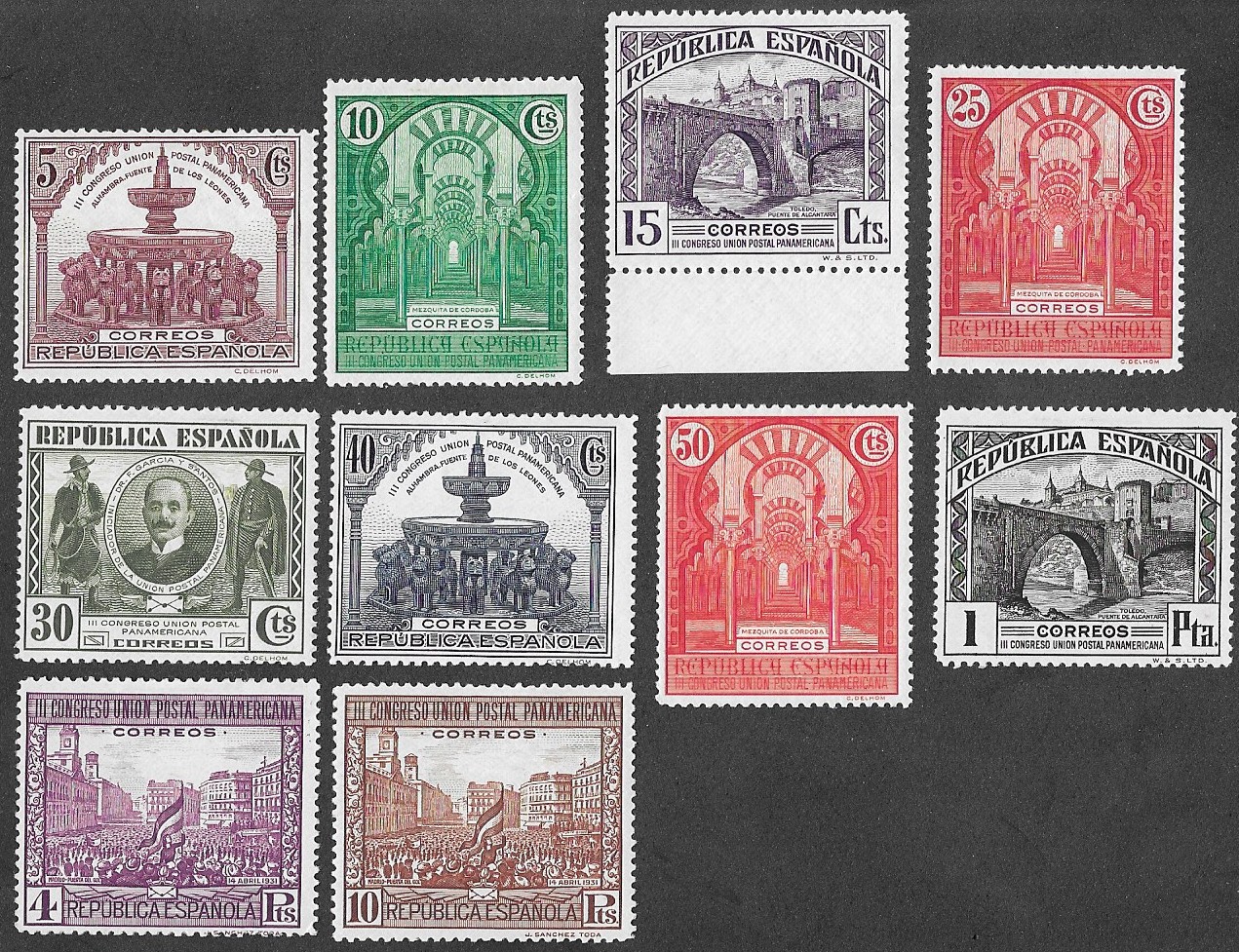
The ordinary-post issue consists of ten stamps, numbered Edifil 604–613.
| Edifil | Value | Subject |
|---|---|---|
| 604 | 5c | Fountain of the Lions, Granada |
| 605 | 10c | Mosque of Córdoba |
| 606 | 15c | Alcántara Bridge, Toledo |
| 607 | 25c | Mosque of Córdoba |
| 608 | 30c | Francisco García Santos |
| 609 | 40c | Fountain of the Lions, Granada |
| 610 | 50c | Mosque of Córdoba |
| 611 | 1p | Alcántara Bridge, Toledo |
| 612 | 4p | Proclamation of the Republic, Madrid |
| 613 | 10p | Proclamation of the Republic, Madrid |
What Is Pictured on Each Stamp?
Edifil 604 — 5 Céntimos: The Fountain of the Lions
The first denomination features the celebrated Fountain of the Lions in the Alhambra at Granada. Twelve sculpted lions support the fountain basin, surrounded by the slender columns of the Nasrid palace.
This is an exceptionally intricate subject for an engraved stamp. Under magnification, collectors can study the fine lines representing the lions, fountain and surrounding architecture.
Edifil 605 — 10 Céntimos: The Mosque of Córdoba
The magnificent interior of the Mosque-Cathedral of Córdoba is represented through its famous succession of arches and columns.
The perspective creates an impression of architectural depth within a remarkably small printed surface. Look particularly at the sharpness of the arches and the separation of the vertical lines.
Edifil 606 — 15 Céntimos: The Alcántara Bridge
The 15-céntimos denomination portrays the Alcántara Bridge over the River Tagus in Toledo, with the historic city rising behind it.
The bridge is of Roman origin, although rebuilt and altered over successive centuries. Its monumental arch provides a strong central composition.
On mint examples, inspect the original gum and perforations as carefully as the engraved design. Attached sheet margins are also worth preserving.
Edifil 607 — 25 Céntimos: Córdoba in a Different Colour
The second Córdoba denomination repeats the Mosque design in a contrasting colour.
Placing the 10c and 25c stamps side by side is a useful exercise in studying recess printing. The engraving remains the same, but the colour changes the appearance of architectural depth and fine detail.
Edifil 608 — 30 Céntimos: Francisco García Santos
One of the most historically interesting stamps honours Francisco García Santos of Uruguay, associated with the development of Pan-American postal cooperation.
His portrait occupies the central oval, accompanied by standing figures and lettering referring to the Pan-American Postal Union.
The stamp reminds us that this issue commemorated an international institution rather than simply a Spanish event.
Edifil 609 — 40 Céntimos: The Alhambra Revisited
The Fountain of the Lions returns on the 40-céntimos denomination, now printed in a darker colour.
Compare it with the 5c stamp. The interplay of line density, shadow and colour makes these two stamps particularly rewarding to examine under a magnifying glass.
Edifil 610 — 50 Céntimos: Córdoba in Vermilion
The third Mosque of Córdoba stamp uses a bright vermilion shade.
Together, the 10c, 25c and 50c form a small study group illustrating the effect of different printing colours on an identical engraved design.
Edifil 611 — 1 Peseta: Toledo’s Historic Bridge
The black one-peseta stamp returns to the Alcántara Bridge. The strong contrast of the black engraving emphasises the masonry, the bridge arch and the buildings overlooking the Tagus.
For collectors, the principal examination points are the clarity of the engraved lines, centring and the completeness of the perforations.
Edifil 612 — 4 Pesetas: The Birth of the Second Republic
The four-pesetas stamp introduces a very different subject: the crowds gathered in Madrid’s Puerta del Sol during the proclamation of the Second Republic on 14 April 1931.
The engraved scene captures the political excitement of that day. Crowds, flags and buildings are compressed into an unusually detailed miniature composition.
This higher denomination deserves especially close examination for gum condition, paper thinning and repairs. A beautiful front can conceal a significant fault on the reverse.
Edifil 613 — 10 Pesetas: The High Value
The final stamp repeats the Puerta del Sol scene in reddish-brown.
It is the highest denomination in the ordinary-post series and one of the most important stamps when evaluating a complete set.
Well-centred examples with sound paper, attractive colour and carefully preserved original gum are especially desirable.
Printing and Technical Characteristics
The series was recess printed (calcografía) by Waterlow & Sons Ltd. in London.
- Issue: Third Pan-American Postal Union Congress
- Date: 10 October 1931
- Country: Second Spanish Republic
- Catalogue: Edifil 604–613
- Number of stamps: Ten
- Printing: Recess printing
- Printer: Waterlow & Sons Ltd., London
- Perforation: 12, line perforation
Three Things Collectors Should Examine
1. Completeness
A complete ordinary-post set contains all ten denominations, including the 4p and 10p high values. The associated airmail series, Edifil 614–619, is a separate six-stamp issue and should be catalogued independently.
2. Original Gum and Paper Condition
The difference between MNH, MLH and more heavily hinged examples can be substantial. Examine the reverse for hinge traces, disturbed gum, toning and particularly paper thinning.
Even a small thinning should be disclosed in an accurate philatelic description.
3. Engraving and Centring
The architectural designs are especially suitable for comparing impression strength. Look for clean detail in the columns, arches, bridges and buildings. Balanced margins and complete perforations also contribute to a stamp’s visual quality.
From the AllCollect Collection: S351
Our collection contains a complete ten-stamp example of Edifil 604–613, recorded as AllCollect S351.
Nine stamps are classified Mint Lightly Hinged (MLH), while the 15-céntimos stamp is Mint Never Hinged (MNH).
The four-pesetas stamp has a confirmed thinning in its upper-left corner. This reduces its individual condition and value, even though the set remains complete.
The ten-pesetas stamp, by contrast, is a Very Fine MLH example.
This contrast illustrates an important collecting principle: the condition of individual key stamps matters more than the general appearance of a complete set.
- Completeness: 10/10
- Collection Grade: 3.5/5
- Investment Grade: 2/5
- AllCollect valuation: €32
- Collection decision: KEEP
Why This Series Is Worth Collecting
The 1931 Pan-American Postal Union Congress stamps bring together architectural heritage, international postal history, fine engraving and one of the great political turning points in modern Spanish history.
They are an excellent starting point for studying the philately of the Second Republic. Their repeated designs make comparisons easy, while the high denominations offer worthwhile lessons in grading and condition-sensitive valuation.
Above all, they remind us that postage stamps are not simply miniature works of art. They are historical documents, reflecting how nations wanted to present themselves to the world.
Collectoria — Exploring the history, craftsmanship and value behind collectible stamps.
Collection reference: AllCollect S351. Catalogue values and individual condition assessments should always be checked against the edition of the catalogue being used.