
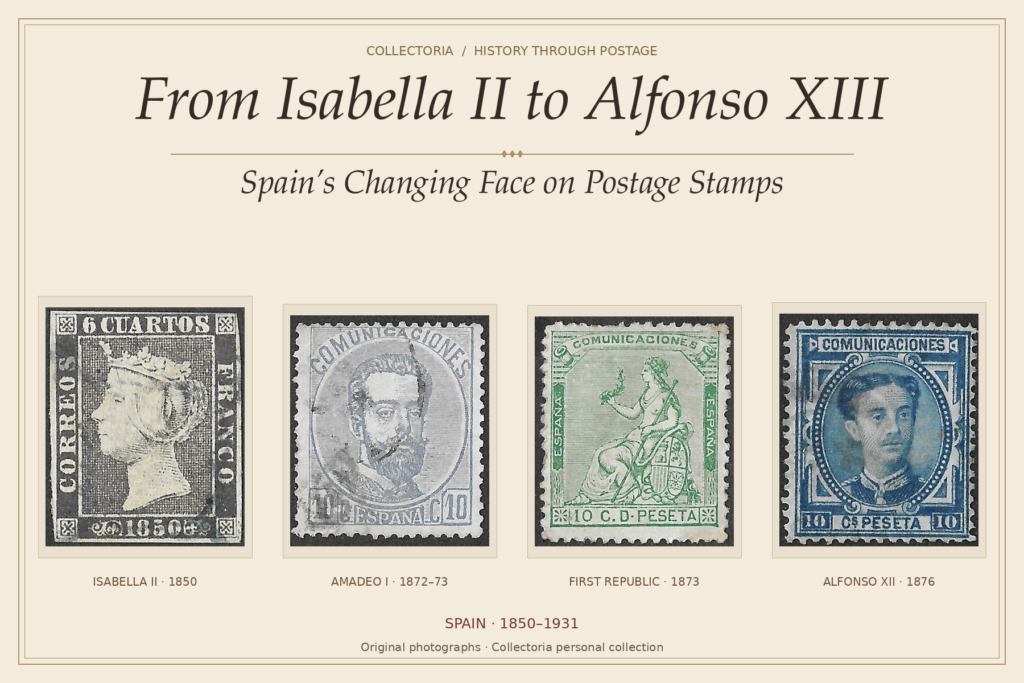
From Isabella II to Alfonso XIII: Spain’s Changing Face on Postage Stamps
Spain’s first stamp carried a queen’s profile. Eighty-one years later, a republic put its own name across a king’s portrait. The stamps in between tell a surprisingly readable political history.
Spain · 1850–1931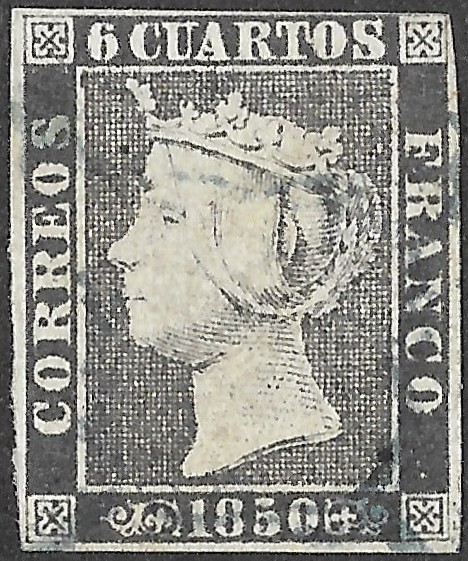
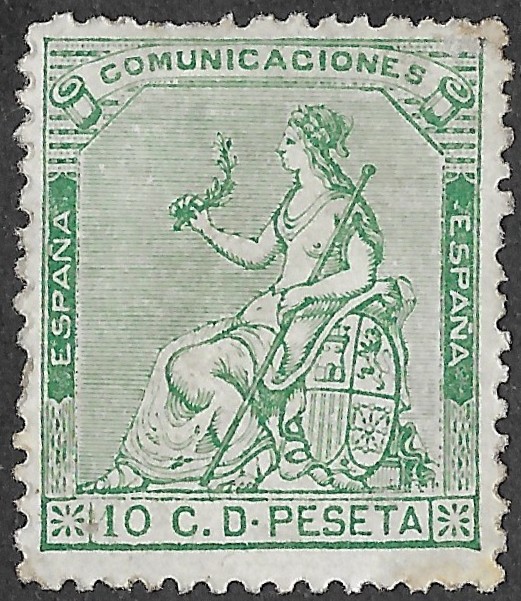
On a black six-cuarto stamp, Isabella II is easy to recognise even through the faint cancellation. A green stamp of 1873 shows a woman as well, but she is seated and has no royal name. She represents a republic. Those two stamps make a good introduction to Spanish philately. They look small and rather ordinary until you ask why one woman is there and the other has gone.
Spain’s first postage stamp went on sale on 1 January 1850. It was black, cost six cuartos and carried the head of Isabella II. The example pictured here belongs to that first issue. What appeals to me is how little the design needs. The inscription tells you what the stamp is for and what it costs.
The face tells you whose Spain it is.
It was printed without perforations and cut from its sheet. Those narrow margins are worth a moment’s attention. Someone had to separate this stamp from its neighbours before putting it on a letter. Postal convenience still required a pair of scissors.
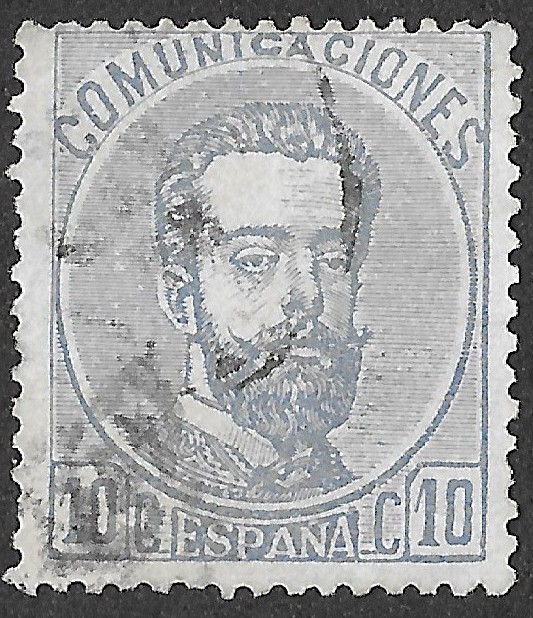
Isabella lost her throne in the revolution of 1868. Spain still had letters to deliver while it worked out who should govern. During the regency, an issue of 1870 gave Spain itself a face, in the form of a female allegory. The Cortes chose Amadeo of Savoy as king, and by 1872 he had an oval of his own. He abdicated in February 1873. It was a brief engagement, as royal engagements go. The First Republic was proclaimed that same month and issued stamps with an allegory of its own. Put the bearded Amadeo beside the green ten-céntimo republican stamp and the change is immediately visible. The seated figure occupies much of the design. After all those royal profiles, she seems to have made herself quite comfortable.
A King and a Republic
1873 — Amadeo I abdicates; the First Republic is proclaimed.
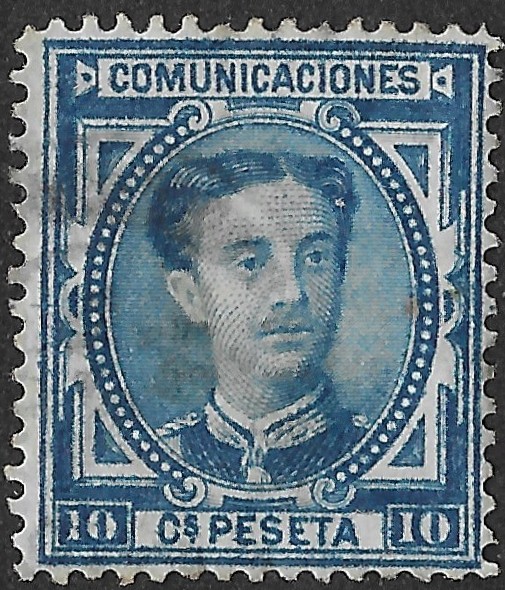
By the end of 1874 the Bourbons were back, and a family resemblance returned to the post. The new king, Alfonso XII, was Isabella’s son, and he began appearing on postage stamps in 1875. On the blue ten-céntimo example of 1876, his portrait sits beneath the word Comunicaciones. Amadeo’s stamp uses the same word. I rather like that small continuity. A portrait could change with the regime while the postal administration carried on using familiar language. It is rather like seeing the same letterhead with a different signature.
The Bourbons return
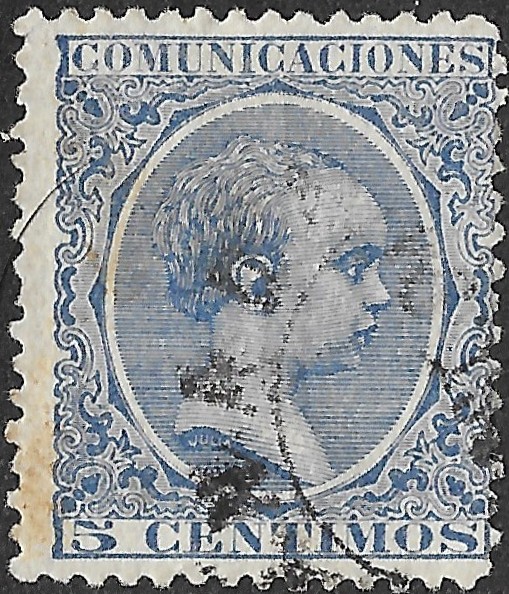
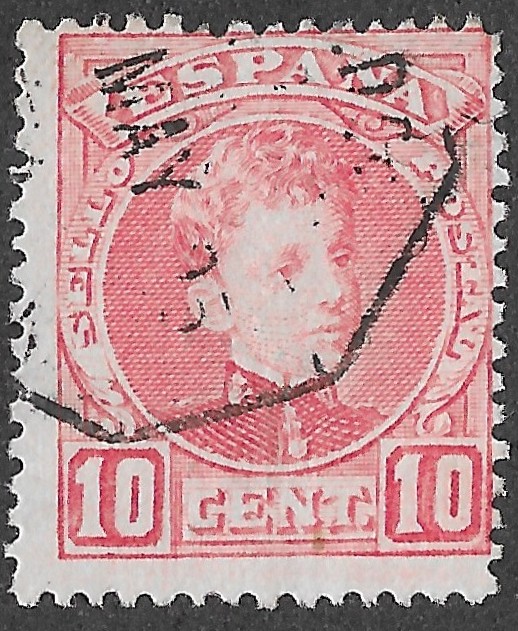
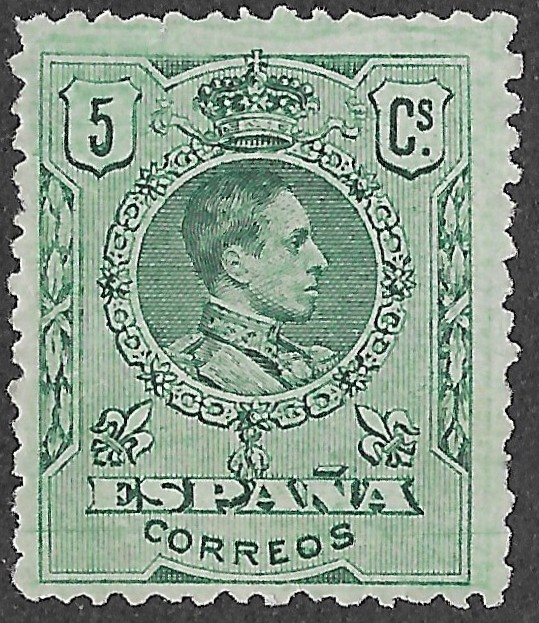
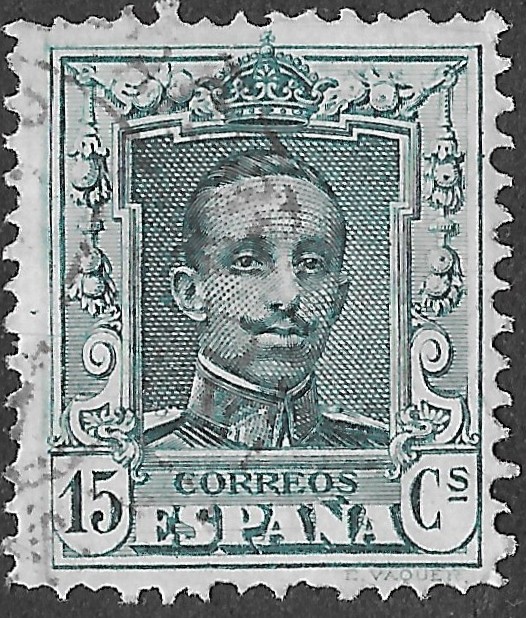
Alfonso XII died in 1885. His son was born the following year and was king from birth, while his mother, María Cristina, served as regent. In 1889 the boy’s portrait appeared on a set collectors call the Pelón, after the child’s nearly bald appearance. The Cadete design followed in 1901, still during the regency. By 1909 the Medallón showed a grown man in profile. The frontal Vaquer portrait of 1922 changes the view again. Put those four designs in order and you can watch one person age across the ordinary stamps people bought to send their letters.
The reign dates alone would never tell you what that looked like.
Collectors have even supplied the chapter titles. For once, their nicknames make the history easier to remember.
The Four Faces of Alfonso XIII
Pelón · Cadete · Medallón · Vaquer
Object captions
- Alfonso XIII as a child on the blue five-céntimo Pelón design of 1889. Collectoria personal collection, S213.
- Alfonso XIII in uniform on the red ten-céntimo Cadete design of 1901. Collectoria personal collection, S231.
- Alfonso XIII in profile on the green five-céntimo Medallón design, introduced in 1909. Collectoria personal collection, S246.
- The frontal portrait of Alfonso XIII on the grey-blue fifteen-céntimo Vaquer design of 1922. Collectoria personal collection, S276.
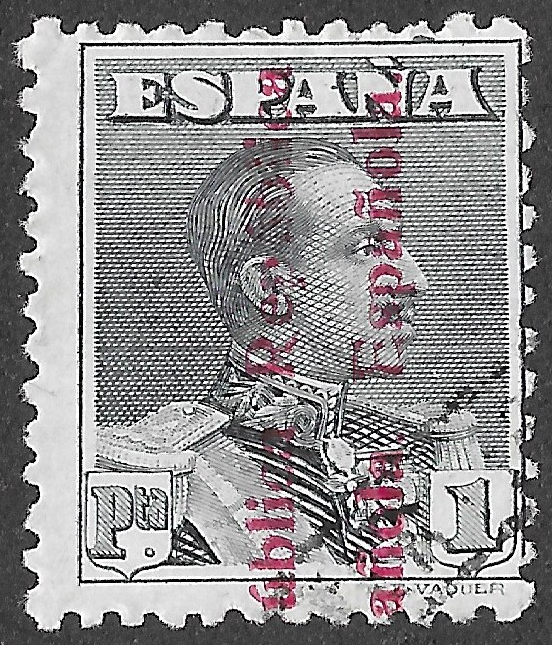
After the municipal elections of April 1931, Alfonso XIII left Spain and the Second Republic was proclaimed on 14 April. Some existing royal stamps were overprinted with the words República Española. On the one-peseta example shown here, the carmine lettering runs vertically across the former king’s portrait. There was a new name to print and a stock of perfectly serviceable stamps already on hand. The overprint solved the immediate problem and left a small irony for collectors. You can read the Republic’s name and see the king it replaced without moving your magnifying glass. There is something rather satisfying about a political transition that remains so plainly visible.
República Española
For me, following the portraits is one of the pleasures of these ordinary stamps. The denomination, the inscription, the direction of the face and the shape of its frame gradually become familiar. Then another example turns up and makes you look again. The same king and the same denomination can appear in several designs. A legible postmark may add a town or date; margins and perforations raise questions of their own. There is plenty left to work out, even after the larger story begins to make sense.
Put these stamps in order and the succession looks almost tidy. The politics behind it were considerably less so. On a letter, of course, any one of these stamps would have had the corner to itself. Whoever put it there might have paid more attention to the address than to the face. Governments had their reasons for choosing what went in that corner. The person writing the letter wanted it to arrive.
Sources and Further Reading
- Correos — Spain’s nineteenth-century stamps.
- Congreso de los Diputados — The Revolutionary Six Years, the Restoration and April 1931.
- FESOFI stamp catalogue — Pelón, Cadete, Medallón, Vaquer and the 1931 republican overprint.
- Real Academia Hispánica de Filatelia — Academvs 12, on the First Republic’s 1873 issue.