
Secrets of Collecting · 001
A Hole in a Stamp?
Don’t Throw It Away!
A small piece of paper. A missing circle. A surprisingly good story.
SPAIN · 1874–1889
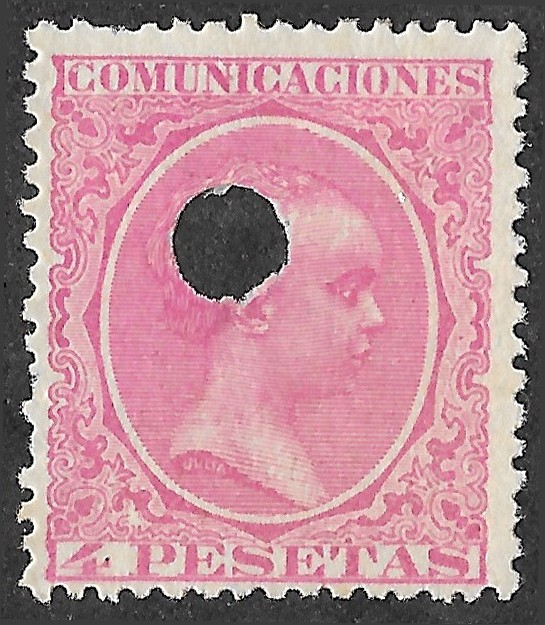
Circular punch; telegraphic attribution provisional.Collectoria · LOT-CA-044 · original photograph
When we collect old postage stamps, we naturally look for examples in the best possible condition. Good centring, attractive colours, intact perforations — and certainly no holes!
But sometimes a hole is precisely what makes a stamp interesting.
Take a look at this Spanish four-peseta stamp issued in 1889. It features the young King Alfonso XIII and belongs to the series affectionately known among Spanish collectors as El Pelón — the little bald one.
Someone has punched a rather large hole through the King’s portrait. At first glance, it looks like a perfectly good stamp has been ruined.
There is, however, a much more interesting explanation.
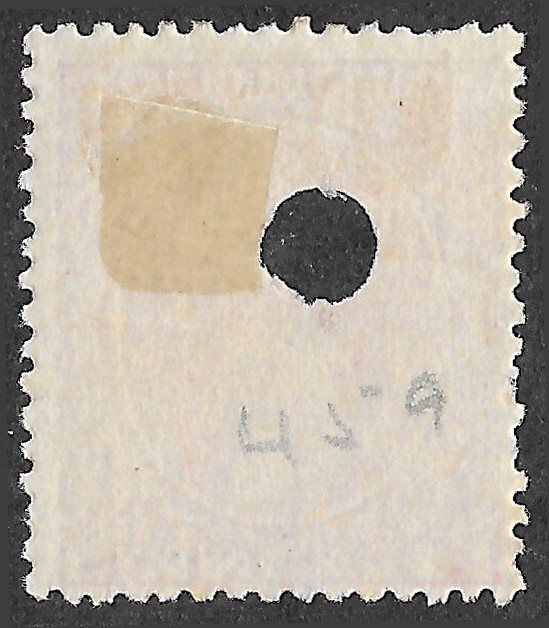
The missing paper is visible from both sides.Collectoria · LOT-CA-044 · original photograph
LOOK AT THE WHOLE OBJECT
The other side of the story
The reverse preserves the same circular opening, together with old mounting traces and pencil marks. A neat hole may suggest deliberate punching, but its precise origin still needs evidence.
Before emails and mobile phones
Imagine living in Spain in the late nineteenth century. You need to send an urgent message to Madrid. A letter might take days, but a telegram could carry your news much faster.
Sending a telegram cost money, and stamps were used to record payment for this service.
The telegraph clerk needed a way to prevent those stamps from being used again. One particularly effective method was to punch a hole through them.
Spanish telegraph regulations dated 8 June 1864 actually instructed officials to perforate stamps attached to telegrams when they were received at the sending station. [1]
During the reign of Alfonso XIII, stamps bearing the inscription Comunicaciones could serve both postal and telegraphic purposes. [2]
This explains why we sometimes find two otherwise identical stamps with very different appearances: one with an ordinary postal cancellation and another with a large punched hole.
TWO COPIES · ONE DESIGN
Ink or a hole?
These two one-peseta stamps from 1874 show the distinction particularly clearly.
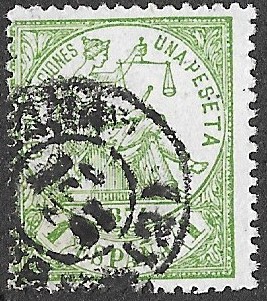
Spain, 1874 · First Republic · 1 peseta green · Edifil 150.
Heavy black cancellation; no punched hole.Collectoria personal collection · S184 / AC-13925
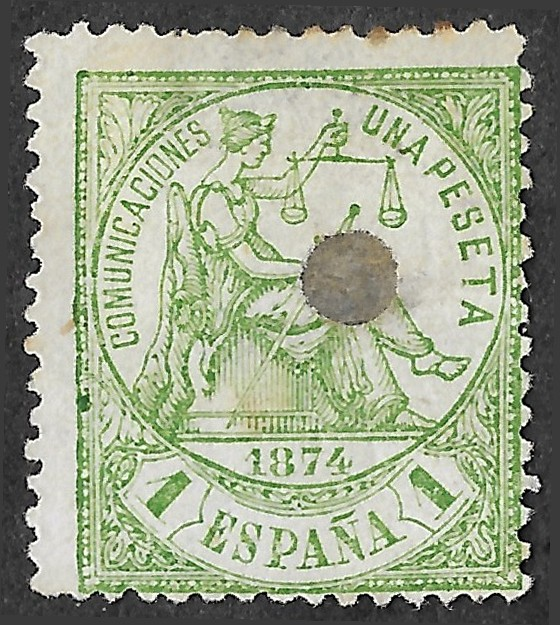
Spain, 1874 · First Republic · 1 peseta green · Edifil 150.
Punch consistent with telegraphic use; attribution provisional.Collectoria personal collection · S530
Is a stamp with a hole worth collecting?
Absolutely, although that does not necessarily mean it is worth more money.
Some of these Spanish stamps can be considerably more affordable with telegraphic cancellations than with ordinary postal cancellations, depending on the issue and condition. For collectors on a modest budget, they can offer a particularly interesting way to explore classic issues. [2]
There is one important thing to remember, though. Not every hole is an official cancellation. Some stamps were damaged accidentally, while others were perforated with tiny letters or symbols by businesses to discourage theft. These are known as perfins and are a fascinating collecting subject in their own right. [3]
SIMILAR MARKS · DIFFERENT QUESTIONS
The shape is a clue, not a verdict
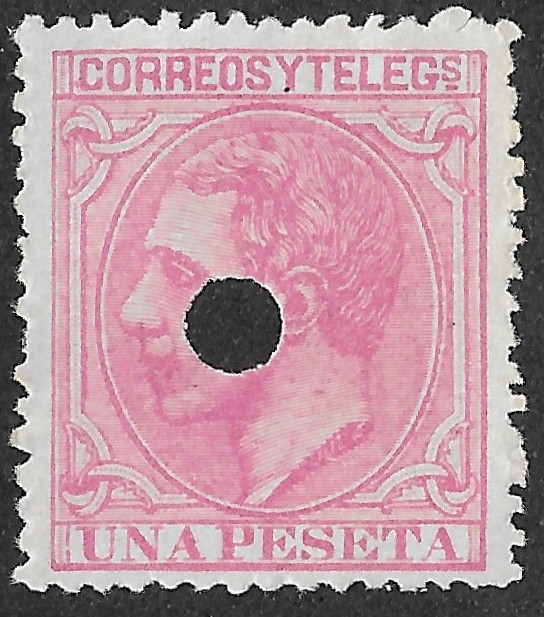
Spain, 1879 · Alfonso XII · 1 peseta rose · Edifil 207.
Probable telegraphic punch; the individual use is not certified.Collectoria personal collection · S207 / AC-14020
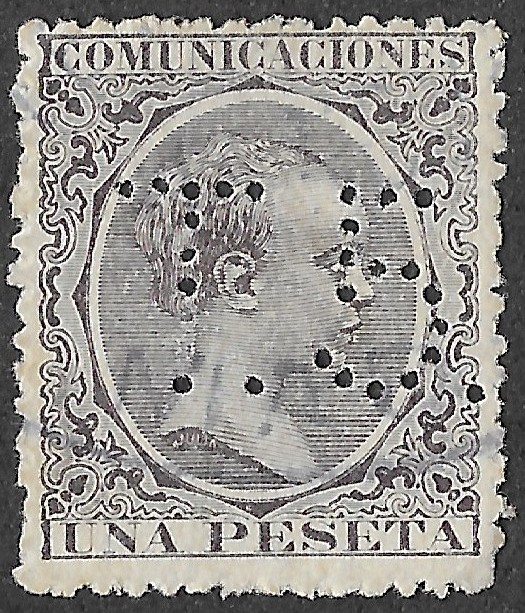
Spain, 1889 · Alfonso XIII · 1 peseta blackish violet · Edifil 226.
Figured punch, recorded as “T5”; exact purpose unverified. It is not identified here as a company perfin.Collectoria personal collection · S223 / AC-14080
The circular hole in our Alfonso XIII stamp is consistent with telegraphic use, although its precise origin has not been independently certified.
For me, much of the pleasure of collecting comes from discovering why a stamp looks the way it does. A small piece of paper can tell us surprisingly much about how people lived, worked and communicated.
So, the next time you find a stamp with a hole in it, put the tweezers down for a moment and take a closer look.
There might be a rather good story hiding in that hole.
Happy collecting!
— Collectoria
Further Reading
[1] José María Mathé, Instrucción sobre correspondencia telegráfica, Madrid, 8 June 1864, section 5; reproduced in the Almanaque Literario del Museo Universal (1865).
[2] Telegraph Stamps of the World: Spain — combined postal and telegraphic issues and punch cancellations. Historical price comparisons illustrate the distinction; they are not current valuations.
[3] The Perfins Club — initials, designs and numerals perforated to discourage theft and misuse.
FESOFI: Edifil 227 — the 1889 four-peseta rose Pelón issue.
All specimen photographs: original Collectoria collection and inventory images. No specimens have been digitally reconstructed.